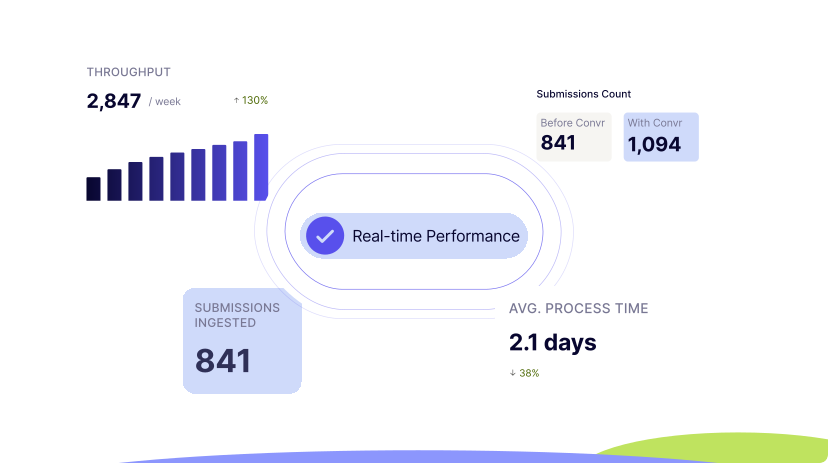

Improve Operational Efficiency

Process more submissions without adding headcount.

Proven Impact

How Insurance Operations Teams Improve Efficiency With Automation

Convr delivers measurable improvements across efficiency, speed, and underwriting performance.

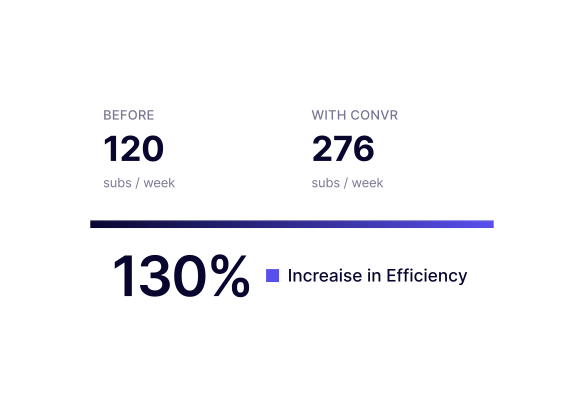
130% Increase in Operational Efficiency

Automate manual processes and enable teams to process significantly more submissions with the same resources.

15% Higher Win Rate

Respond faster and prioritize the right risks to improve conversion and drive premium growth.

Operations Leaders Get

Get Immediate Performance Visibility with Historical Data Repository

Team-level throughput visibility

Track underwriter throughput, decision velocity, and submission-to-quote ratios across your entire team. Identify who needs support and who's ready for more responsibility.

SLA monitoring and alerts

Set thresholds for processing time, quote turnaround, and bind cycle. Convr flags submissions at risk of breaching SLA before they actually do.

Carrier-ready performance reporting

Live program performance dashboards your carrier partners can review on demand — proving disciplined underwriting without quarterly reporting overhead.

Operational Excellence

Improve operational efficiency without adding headcount.

Human + AI Collaboration

AI with Human-in-the-loop (HITL) scales, improves productivity, and governance.

Expert Review

Underwriters Stay in Control

Convr AI ingests and structures submission data, while underwriters review, validate, or adjust key fields – ensuring accuracy before information moves into downstream systems.

Learning System

Smarter with Every Interaction

User feedback and corrections help refine AI outputs over time, improving data quality, extraction accuracy, and overall underwriting efficiency.

Resources

Dive Deeper into Convr

Access thought leadership, industry insights, and practical resources to modernize underwriting and drive better outcomes.

News

Convr® Unveils the Risk Context Engine, Grounding AI Underwriting in a Commercial P&C Knowledge Graph and Ontology

CHICAGO (June 9, 2026) – Convr® today unveiled the Convr Risk Context Engine (RCE), the industry's first knowledge graph and semantic ontology built specifically for commercial property and casualty (P&C) underwriting. Calibrated on a decade of production data and more than 2,500 integrated sources, the RCE powers every AI capability across the Convr AI Underwriting Workbench and gives carriers and MGAs the grounded, explainable foundation that agentic and generative AI alone cannot provide.

Carriers, MGAs and brokers are evaluating agentic agents, generative assistants, and large language models at an unprecedented pace. Most of these tools share a critical weakness: they are built on general-purpose foundation models with limited understanding of commercial insurance and not calibrated on real underwriting environments. The result is AI that can be inaccurate, inconsistent, irreplicable, and unexplainable. Underwriters, chief underwriting officers, and regulators cannot accept those qualities in risk decisioning.

The Convr RCE solves that problem. Built and refined since Convr's first founding, the RCE is a commercial P&C knowledge graph and semantic ontology that encodes the language, structures, exposures, classifications, and decision logic of underwriting into a unified, machine-readable model, calibrated against a decade of real submissions, real exposures, and real underwriter feedback from leading carriers in production. Every AI capability in the Convr workbench from intake to business classification, risk scoring, data enrichment, and workflows, runs on top of the RCE. The result is AI that doesn't just sound right. It is right, and can prove it: every classification, appetite call, and risk-score output traces back through the ontology to the source submission documents, loss data, and underwriter decisions that informed it.

The regulatory direction is reinforcing the value of RCE. The NAIC Model Bulletin on the Use of Artificial Intelligence Systems by Insurers, now adopted in some form by roughly half of US states, requires governance, transparency, and accountability for AI in regulated underwriting decisions, with parallel frameworks in New York, Colorado, and others. Those outcomes are not achievable on top of black-box inference; they require AI grounded in an inspectable knowledge graph and ontology of the underwriting domain. That is exactly what the RCE provides, with every decision traceable to the ontology and source data behind it.

"The industry is having the wrong conversation about AI in underwriting," said John Stammen, Chief Executive Officer of Convr. "Everyone talks about models. The real question is what they're grounded in. Without a commercial P&C knowledge graph and ontology underneath them, generative and agentic AI are confident guessers. The RCE supplies the missing context . . . what a submission means, what an exposure is, what an underwriter decides and turns outputs into decisions a carrier can defend. This is exactly what Convr has been building since 2016."

Availability
The RCE powers all Convr AI Underwriting Workbench deployments today. Carriers, MGAs and brokers interested in learning more can visit convr.com or contact a Convr representative.

Media Contact
Alex Williams
Senior Promotions Manager
alex.williams@convr.com
217-737-2782

News

New Convr Survey Reveals a Confidence Gap in Commercial P&C: Carriers Are Adopting AI Faster Than They Can Build a Strategy for It.

CHICAGO (June 2, 2026) — Convr®, the leading AI underwriting workbench purpose-built for commercial P&C insurance, today released findings from its 2026 Convr Insurance Talent and Tech Trends Survey, revealing a striking gap between how quickly carriers are adopting AI in underwriting and how confident they are in the strategy guiding that adoption.

The survey of 211 commercial insurance professionals — including a majority at the leadership, vice president, and executive levels — found that AI adoption in underwriting is accelerating across the industry, yet strategic clarity is lagging.

The pace of adoption is undeniable:

  • 89.5% of respondents expect more underwriting tasks to be automated in the coming years
  • 70.6% delivered new AI underwriting tools to their teams in 2025
  • 65.9% plan to deliver additional AI tools in 2026
  • 53.6% have AI deployed in at least one production underwriting workflow

But strategic confidence has not kept pace:

  • Only 20.4% of leaders are "highly confident" their organization has a clear, actionable AI strategy for underwriting
  • More than 40% rate themselves in the bottom half of the confidence scale
  • 56.9% describe their organizational culture toward AI as "cautiously open — interested but wanting proof before commitment"
"The industry has crossed a threshold," said John Stammen, Chief Executive Officer at Convr. "AI in commercial underwriting is no longer a question of whether, but a question of how. What our survey reveals is that while carriers are moving quickly to deploy AI tools, many are doing so without the strategic framework to ensure those investments deliver lasting business outcomes.”

That gap between adoption and strategy is the single biggest risk facing commercial P&C leaders today, and it's also the biggest opportunity. The carriers who close it first will define the next decade of underwriting, according to Stammen.

The survey also surfaced the operational realities driving urgency around AI adoption. Respondents pointed to manual data entry (35.1%), dated and legacy technology (27.5%), and too many submission data sources (24.6%) as the leading factors slowing underwriting at their companies today. Meanwhile, 63% of carriers operate on hybrid technology environments — a legacy core with cloud-based tools layered on top — underscoring why a unified, AI underwriting workbench has become a strategic imperative rather than a nice-to-have.

Stammen noted that beneath Convr’s underwriting workbench is a data-first architecture purpose-built for commercial underwriting, not an AI layer bolted onto legacy systems. At its core is Convr’s Risk Context Engine, a unified intelligence framework that connects structured and unstructured submission data, business logic, and AI models into a single source of truth, grounding AI decisions in real underwriting context rather than generic output. Powering the engine is Risk 360, Convr’s proprietary insurance data lake, with 10 years of historical underwriting data continuously enriched by more than 2,500 public and private sources and 785 million data points on 87 million companies. Together, they give carriers what point AI tools cannot — a strategic foundation that turns AI adoption into repeatable, measurable underwriting outcomes.

When asked what would most benefit their underwriting teams, respondents pointed to AI tool training (47.4%), pre-screened and enriched submissions (46.9%), and simplified access to data (45.5%) — all areas where Convr's modular workbench is actively helping carriers close the strategy-to-execution gap today.

"Strategy without execution is theory. Execution without strategy is chaos," said Stammen. "Convr was built to give carriers both a clear path from where their underwriting operates today to where it needs to be tomorrow."

About the 2026 Convr Insurance Survey

The 2026 Convr Insurance Survey was conducted in April and reflects responses from 211 commercial insurance professionals working in property and casualty, with strong representation from leadership (35.1%), VP/Executive (37%), and management (42.2%) roles across carriers, MGAs, brokerages, and specialty markets.

For more information, visit convr.com.

Blog

Glean Insights on Hard-to-Find Small Businesses with Convr’s Biz Intel Feature

A huge portion of commercial property and casualty (P&C) insurance applicants barely exist online. Many small and mid-size commercial insureds (the bread and butter of commercial insurance underwriting) are nearly invisible online.

Think about it . . . landscapers, contractors, florists and more. The  food truck owners, small town auto mechanics and mom and pop shops . . . many don’t have:

  • a website
  • a strong social media presence
  • consistent business filings
  • complete insurance applications

Underwriting team members call this a low digital footprint risk and it’s a problem for them. When the submission comes in, they need to know if the business is real, if the owners do what they claim to do, and if the exposure is what the agent says it is.

But if the business has no digital presence, the underwriter is lost without their normal verification tools including website and online reviews, access to pertinent safety records and satellite exposure checks as well as prior filings.

That’s where Convr’s AI Underwriting Workbench shines. With our Biz Intel web search feature for low digital footprint companies, that hard to find information easily turns up for the underwriter within our underwriting platform.

The Convr Underwriting Workbench’s Biz Intel can uncover:

1) Business Classification

2) Appetite relevant exposures

3) Number of employees

4) Revenue

It turns an unknown into a knowable risk, giving the underwriter the opportunity to decide whether or not to write the risk rather than to spend time investigating it further. It’s a shortcut for underwriting team members of all levels as they spend less time searching for the details that move the decision.

All in one place:

In the Convr AI Underwriting Workbench, every new submission with the web option enabled, runs Biz Intel and returns the results inline. The hard-to-find details land next to the submission you're working on, not three tabs away from it.

Why it matters:

Low-digital-footprint submissions take time that underwriters often can't justify spending. Enrichment surfaces the missing data automatically, so accounts that would have been deprioritized or declined for lack of information become writable.

Convr’s Biz Intel users get:

1) First-quote advantage: Brokers place business with the first to quote. If your underwriting team is out searching Google, the Secretary of State, checking maps and emailing questions – you could be missing out on deals. With Convr AI data enrichment, the data comes to the underwriter instead of the other way around – and the first quote is more often yours.

2) Reduced referral dependency: When reliable information on low digital footprint companies is available in the file, more submissions can be decided where they land. Junior underwriters escalate only the accounts that genuinely need a second set of eyes. Senior underwriters spend their time on the complex risks and judgment calls that actually require their experience – not on questions a richer file would have answered on its own. Across the team, consistency improves and cycle times tighten.

3) Greater portfolio profitability: This is the real return on investment. Commercial carriers rarely lose money on catastrophic risks. Instead, they lose money on thousands of slightly mispriced/misunderstood small and mid-size policies – and low-visibility insureds are exactly where this is most common.

Convr's AI Underwriting Workbench isn't a productivity system. It's a loss ratio control system. If thin-file submissions are costing your team time or premium, we should talk – visit us at convr.com today.

Frequently Asked Questions

Find quick answers to common questions about our platform, capabilities, and implementation.

How much manual work can be automated?

Convr automates a significant portion of operational work by digitizing submissions, eliminating duplicate data entry, pre‑filling forms, routing work automatically, and applying fitness and clearance rules. Manual intervention is reserved for exceptions through Human‑in‑the‑Loop (HITL) review, reducing overall operational effort while maintaining control.

How will Convr improve processing speed?

By automating ingestion, enrichment, prioritization, and workflow routing, Convr accelerates submission processing and reduces cycle time across intake, clearance, and underwriting preparation. Real‑time data enrichment and integrated workflows allow teams to move submissions forward without waiting on manual handoffs.

Can we handle more submissions without adding headcount?

Convr is designed to increase throughput without linear increases in staffing by enabling straight‑through processing for high‑confidence submissions and focusing human effort only where review is required.

Can Convr help standardize workflows across teams?

Convr provides configurable, standardized workflow stages, labels, and routing rules that can be applied consistently across teams, lines of business, and geographies. This ensures repeatable processing, clearer handoffs, and reduced variability in how submissions are handled.

How can insurers scale underwriting without hiring more staff?

Convr removes the manual work that limits underwriting capacity. By automating submission intake, data extraction, triage, and enrichment, it delivers complete, decision-ready risks to underwriters, so they can focus only on evaluating.

Modernize Your Underwriting Workflow

Automate submission intake, accelerate triage, and empower underwriters with actionable risk insights